

In the Ancient Egyptian religion, the Gods and Goddesses were not understood as distant deities removed from the world in which people lived. Their presence was recognized in the natural world, and the relationship between humanity and the Divine was part of everyday life. Trees, animals, and the land itself held religious significance, and many Goddesses were associated with the natural world through their connections to protection, motherhood, and nurturing.
Hathor, one of the most widely revered Goddesses of Ancient Egypt, was known as the Lady of the Sycamore. The sycamore was associated with her presence and offered shade, shelter, and nourishment. The natural world was not separate from religious life; it was one of the ways in which people encountered the Divine.
The Five Gifts of Hathor is a practice that asks us to pay attention to the things in life for which we are grateful. Looking at the five fingers of one’s hand, name five things that are most important. These may be a spouse, children, a beloved animal, or something in the natural world, such as a tree beside a stream. The gifts are personal, drawn from the people, relationships, and surroundings that are part of our lives.
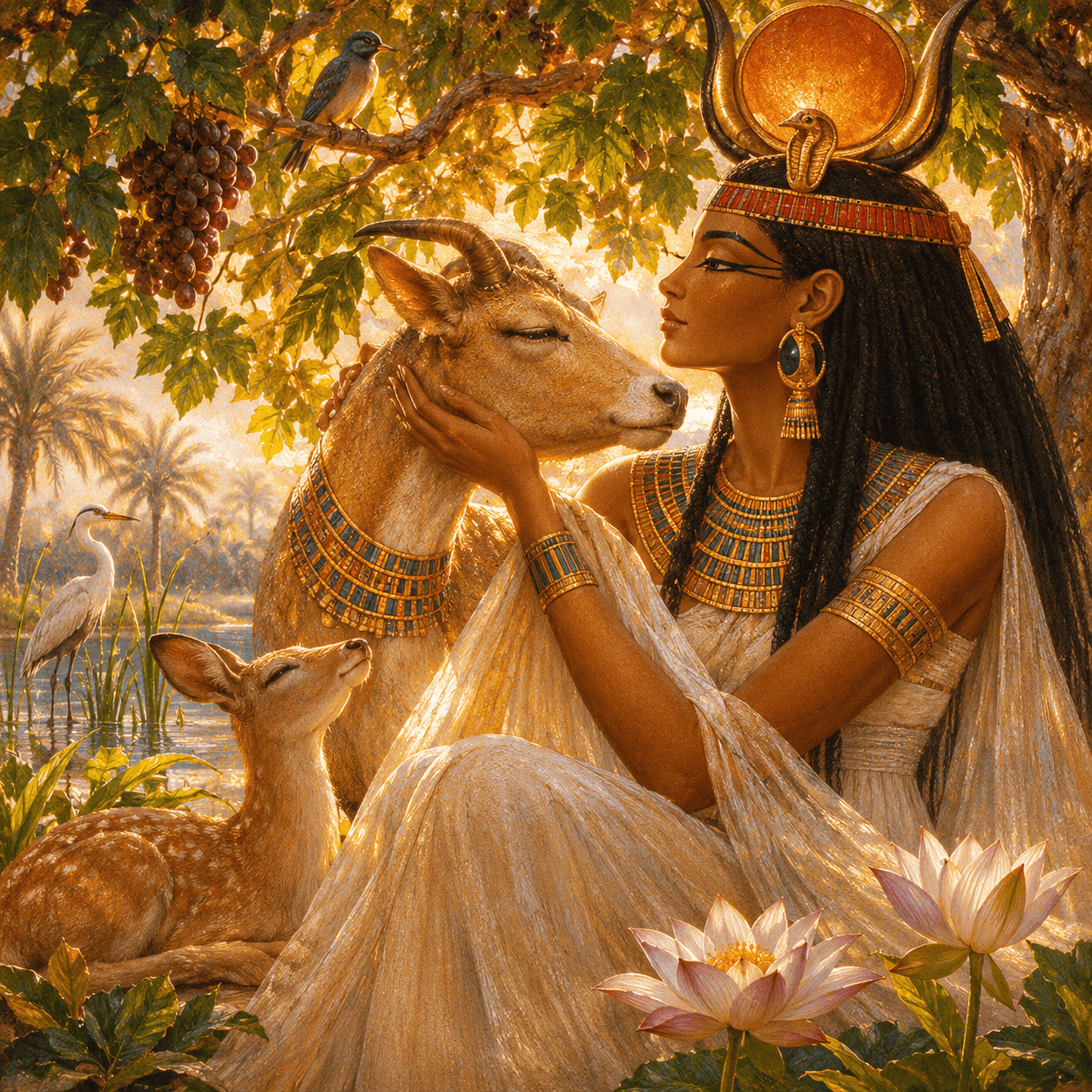
The relationship between gratitude and harmony is common across many religious and spiritual traditions, there is an understanding that our thoughts, choices, and actions affect the balance of our lives and the world around us. Gratitude, compassion, kindness, and respect for others are recurring themes in religious teachings throughout history. Although the beliefs and languages differ, the importance of living in harmony with others and with the natural world is a common theme.
In the Ancient Egyptian religion the way we think and act affects not only ourselves but those around us. When we lose sight of the things for which we are grateful, our thoughts and energies may become directed toward the forces of darkness and chaos.
This practice also has a connection to Ancient Egyptian beliefs concerning death and the afterlife. The heart held particular significance, for it was weighed in judgment before Osiris. In the funerary tradition, the heart was weighed against the feather, and this judgment determined whether the deceased could enter the afterlife of the blessed. The heart held the record of a person’s life, including their actions and conduct.
The relationship between gratitude, love, and care for the world is also expressed in the Hymn to Isis/Aset by Rev. Loreon Vigné. Written in 2003, the hymn addresses Aset through an appeal for compassion, forgiveness, and kindness. It speaks of conflict among people, regardless of their faith or background, and of the destruction of the natural world. The prayer is for a greater understanding of our shared existence and our responsibility toward one another and the Earth.
Hymn to Isis/Aset
Oh Isis, dear Isis
We need you now
For humans living on Earth
Do not know how
To live in peace and harmony
No matter what their path
Men fight and kill each other
With anger, hate, and wrath
They pollute our lovely planet
With poisons that destroy
The wondrous wildlife that abounds
For humankind to enjoy
They strip the green rain forests
Pollute the waters too
Oh Isis, dear Isis
We know not what to do
We need you!
We need your compassion
To teach us all to live
To be more fully human
To learn to forgive
To practice lots of kindness
To all of any faith
No matter what their color
Or religion or their race
To see the universe as one
To worship the Divine
To honor each and everyone
As a beautiful design
To be always thankful
For all that you provide
And honor each and every day
With Isis by our side
Oh Isis, be with us,
Come to us from above
We need your blessed beauty
We need your healing love
We need you!
So Isis from Her place on high
Heard the Priestess plea
She came to Earth to find a way
And gave us this decree
You must just love each other
And give thanks every day
Protect the gifts upon the Earth
And take some time to pray
I am here! I am here! I am here!
Rev. Loreon Vigné
The hymn brings together the concerns of humanity and the natural world. The call to Aset is answered with a message of love, thankfulness, protection of the Earth, and prayer. Although this is a modern hymn rather than an Ancient Egyptian text, it reflects spiritual concerns that extend across religious traditions.
Thankfulness does not mean that life is always kind, nor does it remove the difficulties that accompany being human. We may be grateful for the people in our lives while also experiencing disappointment, uncertainty, or grief. The presence of one does not make the other less real.

The story of Osiris and Aset is one of love, devotion and loss, and it is a central story in the Ancient Egyptian religion. It concerns the death of Osiris, the devotion of Aset, and the transformation of Osiris into the ruler of the afterlife.
Osiris was regarded as a righteous ruler and was associated with kingship, death, and continued existence beyond the physical world. His death at the hands of his brother Set brought about a profound change in the divine order. Aset, his wife and sister, searched for him and used her knowledge and magical abilities in the effort to recover and restore his body.
Osiris does not return to his former position as ruler of the living. He becomes ruler of the realm of the dead, and his role in the divine order takes another form. His association with renewal and continued existence became central to Ancient Egyptian beliefs concerning the afterlife. The deceased could be identified with Osiris, and the hope of continued life was expressed through the rituals and funerary texts associated with him.
The relationship between Osiris and Aset is an important part of this tradition. Their story is not simply an account of death and resurrection. It is also an account of devotion, and of the actions taken by Aset following the death of the one she loved.
Our lives are shaped by love, by the relationships we form, by the things we cherish, and by the losses we experience. We carry the memory of those we have loved, and the influence they have had upon our lives. Loss can leave us with questions that have no answers and feelings that do not simply pass with time. The story of Aset and Osiris speaks of a love that endures through death, and of the devotion of a Goddess whose actions became central to one of the most enduring stories in Ancient Egyptian religion.

You must be logged in to post a comment.